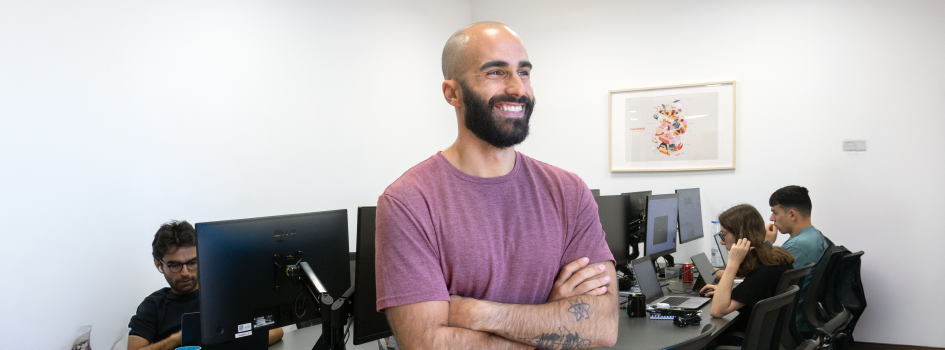
What can be learned from Media & Search after almost 10 years in the industry? Iván Hernández cut his teeth in the company’s content department, where he gained a 360-degree view of the sector. After working on various projects, he decided to make the leap to Media & Search with a clear goal in mind: to understand the consumer journey in order to know exactly what to offer them at any given moment.
From Google to the advent of AI, Iván Hernández has experienced the evolution of Media & Search strategies firsthand. In this interview, he shares his current perspective on the field, along with the opportunities and challenges that this new digital reality brings.
Q: In recent years, the Media & Search landscape has evolved significantly. What key transformation would you say is currently topping the agenda for marketing directors, and how is it changing their approach to driving growth?
A: I would say that one key issue that has been at the forefront for a long time isattribution. It is becoming increasingly complex, not so much because of the attribution models themselves, but due to the lack of transparency from platforms and the sheer range of new media channels emerging. In addition, within this highly complex ecosystem, LLMs have arrived, which are even more complex. They are undoubtedly influencing how users make decisions and interact with brands.
Q:In this context of transformation, there is growing talk about Generative Engine Optimisation (GEO). Why do you think we are facing a paradigm shift in the way brands build their digital visibility? What changes compared to the traditional SEO-based model?
A: The main change is that there is no longer a single major platform; instead, we are facing a fragmented ecosystem. This is due to the high level of saturation on older platforms like Google and Meta.
In SEO, we were used to working for a single platform, namely Google. We would build a strategy there and then apply it to other search engines. In paid media, we were accustomed to working within digital duopolies (Google and Meta), with our entire strategy focused on them. The main issue is that in paid media, the return on investment is more direct, whereas with LLMs we face a great deal of uncertainty—where, as of today, what we are primarily seeing is a drop in organic traffic.
Furthermore, the ecosystem has changed and fragmented. As a consequence, LLMs are emerging within the SEO space. In this new landscape, we find highly distinct platforms such as ChatGPT, Gemini, Perplexity and Claude, each with its own set of rules to guide the user. Consequently, those in senior corporate roles now have to think in terms of completely different strategies, whereas before, a single strategy was enough to dominate the market.
Q: In the GEO reports analyzing the Spanish market we have produced at Good Rebels, we have observed highly significant differences between brands operating within the same market. Which findings have surprised you the most, and what do they tell us about how AI-driven search is evolving?
A: I would highlight two fundamental points. The first is understanding that LLMs are, in essence, probability systems powered by real-time query systems (RAG). This completely changes the traditional approach to positioning projects, where we used to optimise for a closed list of technical factors. Now, we are dealing with probabilistic models that turn to web searches when they require accuracy or freshness. This opens up a direct window of opportunity for us: we can influence the probability of the model mentioning us if we are capable of feeding that real-time search layer, which increases the need to constantly generate up-to-date content.
The second point is how LLMs are redefining source authority, a concept closely resembling traditional SEO. Instead of chasing massive volumes of generic high-authority links, we are now seeing that models assign such a high weight to specific sources that they barely need to query other sites to validate information. If the AI finds what it is looking for in a source highly trusted by its algorithm, it stops the search right there. This opens up a fascinating strategic avenue for brands: we must identify and prioritise these hyper-relevant sources to increase the likelihood of being mentioned. All of this is unfolding against a critical backdrop where, according to Cloudflare data from July 2026, LLM bots already account for 57.1% of HTML content requests, surpassing human activity (42.9%) for the first time.
Q: Despite the differences between industries, have you identified common patterns that recur across all sectors? What do the brands achieving the highest visibility in generative engines have in common?
A: The clearest common denominator is that, as of today, positioning in GEO is a reflection of traditional SEO. Across all analysed sectors (whether banking, insurance, hotels or telco), the brands with the highest visibility in AI are those that already dominated the market and search engines before the arrival of LLMs. There is a very simple explanation for this: the GEO market is still maturing, and there are not yet brands actively trying to ‘hack’ the models or figuring out which levers to pull to overtake their competitors from the outside.
However, the real differentiator lies in each model’s ‘source menu’, and this is where the uniformity breaks down. While Gemini relies heavily on YouTube as its go-to source, ChatGPT behaves very differently depending on the sector: at times, it ignores external citations and relies exclusively on its internal knowledge base to formulate its response. The overarching lesson is that traditional SEO remains the starting point, but real competitive advantage will depend on understanding how each LLM trains and where it searches.
Q: After analysing different sectors and brand behaviour in generative search environments, what would you say are the main keys that any marketing professional should understand to adapt their strategy to this new reality?
A: The first is prioritising. We are at a point where there are many LLMs models, and therefore many opportunities to try to improve our positioning. Furthermore, as of today, very little information is available. Consequently, the strategies we implement regarding positioning or content generation may or may not yield a direct return on those metrics. At the same time, there is still a high level of uncertainty regarding the technical factors that influence positioning within LLMs.
Secondly, I would focus on being technology-agnostic. There are many tools out there that offer to analyse your brand’s visibility across LLMs. However, many of these tools analyse visibility with a low level of personalisation. Therefore, what matters is not just the tool we use, but the analysis we carry out, the metrics obtained, and above all, the action plan derived from that analysis.
Finally, if we have never demanded a direct ROI from traditional SEO, I believe we should expect it even less from GEO. We are operating in ecosystems that offer very little transparency to both brands and users. It would be highly idealistic to assume that we will be able to link a GEO action directly to an increase in our ROI. That is why I would lean towards incrementality models rather than direct attribution models, focusing on metrics such as citability, coverage, mention lift, etc. We must demand the right metrics from GEO.
Q: In the conversations you have with clients, what are the main pain points that emerge when addressing GEO? What doubts or barriers do you encounter most frequently, and what mistakes are many organisations making in this early phase of adoption?
A: I wouldn’t dare point to any specific one, because the reality is that, as of today, there are still too many unknowns surrounding what GEO actually is and how we can influence positioning within LLMs.
That said, the biggest pain point is uncertainty. Increasingly—and this is nothing new—marketing is being held accountable for the P&L. If we are already fighting a constant battle in paid media regarding how branding affects performance, then with GEO, this struggle is amplified tenfold.
Wanting to invest in branding without seeing a direct return leads to a loss of traceability over P&L results, which may result in more budget being allocated to performance. However, we know that in the medium-to-long term this has a negative effect, in that we won’t be able to scale without increasing our investment. And I believe that, precisely because of this and the great uncertainty that exists, many brands prefer to keep working on traditional SEO as they always have, because in a way, it still has an effect on GEO. At least until there is more certainty and they understand that GEO also has its own distinct characteristics.
Q: In this new context, where AI selects and synthesises the information it displays to users, what role do brand reputation, branding, and communication play? Do you believe their weight will become increasingly significant within digital visibility strategies?
A: I believe their weight is already immense, but it isn’t fully apparent to us yet. We must remember that models are trained on information, much of which is public and therefore available on the internet. Historically, the way any medium has assigned more or less credibility to information is through the source delivering that message.
Right now, given the sheer volume of information, simply accumulating mentions is not enough; what truly matters is source authority. We are placing too much emphasis on analysing the volume of sources citing the media, rather than on the actual authority they hold. Yet, it is authority that builds a narrative, establishes highly relevant media presence, and drives effective branding and positioning work.