The tournament for attention: How to win over the audience at the 2026 World Cup?
With 51% of consumers identifying themselves as World Cup fans, the tournament represents an opportunity too significant for brands to…
23 June 2026

There’s a scene that repeats itself far too often in marketing meetings: someone puts up a slide showing millions of impressions, thousands of interactions and an upward-trending bar chart. The client nods. The team celebrates. And yet, no one knows for certain whether the campaign actually worked.
Influencer marketing has spent years living off this illusion. A discipline that has evolved from an experimental bet into an established budget line.
In Spain, investment reached €245 million in 2025, representing a 49% increase on the previous year, according to data from Influence Marketing Scope. Yet it still has not solved its most fundamental problem: proving genuine business value.
The challenge is not one of budget. It is one of methodology.
To understand where we are today, it helps to remember how we got here.
Influencer marketing was born from a simple intuition: people trust other people more than they trust brands. That intuition was right, and it still is. But in the process of turning that intuition into an industry, oversimplifications were made, leaving behind an uncomfortable legacy.
In its early years, the sector’s logic was almost mechanical: the more followers someone had, the further your message would reach. Brands bought access to audiences in much the same way they bought television airtime. The creator was a medium, not a collaborator. Success was measured in impressions, because that was what could be measured.
The global market has grown from $1.7 billion in 2016 to more than $32 billion in 2026, according to Influencer Marketing Hub. That growth was so rapid that methodological sophistication simply could not keep pace. Scale increased, but rigour did not.
The result is an industry that now commands meaningful budgets yet still operates, in far too many cases, according to criteria inherited from its most primitive stage: selecting creators based on the size of their audience, assessing success in terms of accumulated impressions, and treating relationships with creators as content transactions rather than strategic collaborations.
When we look at what is happening in the industry today, three recurring tensions emerge, regardless of sector, budget or brand size.
The first is the confusion between activity and strategy. An influencer marketing activity is hiring a creator to post during a campaign. An influence strategy is something entirely different: understanding the role creators play throughout the consumer journey, the narrative you want to build over time, the kind of relationship you want to establish with them, and how all of this connects to business objectives. Most brands do the former while believing they are doing the latter.
The second is the tyranny of superficial metrics. The data is both clear and troubling: 73% of brands are unable to demonstrate the ROI of their influencer marketing investment, despite average returns standing at around $5.78 for every dollar spent. The gap between the real value being generated and the ability to prove it has a name: poor measurement. Brands continue to report views and likes when they should be measuring impact on purchase decisions, brand recall, customer acquisition costs and long-term customer value.
The third tension is the fragility of trust. The most valuable asset in influencer marketing is the credibility of creators. And that asset is being eroded. According to the 2025 Influencer Trust Index by the BBB Programs Trust Institute, nearly half of consumers perceive many influencers as inauthentic, even though 88% say authenticity is a decisive factor in whether they choose to follow and buy. Brands that pursue scale at the expense of affinity are undermining the very mechanism that makes influence work.
 Critical factors that help increase their trust in influencers.
There is something inherently seductive about the informal nature of influencer marketing. It appears that anyone can do it: pick someone with followers, send them the product, publish the content and wait. This perception has been one of the biggest obstacles to the professionalisation of the discipline.
But brands that have worked consistently in this space for years have learnt that intuition does not scale. Intuition works for one-off projects with modest budgets and a high tolerance for error. It does not work when real business objectives are on the table, when investment grows, when senior management begins asking uncomfortable questions about return on investment, or when the creators involved have large audiences and contracts that carry significant commitments.
Nor does intuition protect against the sector’s most costly mistakes: choosing a creator who is culturally misaligned with the brand, launching a campaign without a clear measurement framework, building episodic relationships instead of long-term partnerships, or missing the opportunity to learn from each activation in order to improve the next.
What separates brands that build genuine influence from those that merely accumulate disconnected activations is precisely this: they operate with a method. They have clear criteria for selecting creators. They define measurable objectives before execution. They build and nurture relationships over time. And they learn systematically from every campaign.
When at Good Rebels we ask ourselves how work with creators should be structured, we start from a basic conviction: influencer marketing is not a content distribution tactic. It is a way of building relationships between people and brands through voices that already carry earned credibility.
That conviction changes everything, and it changes it from the very beginning.
Everything starts with the brief, and not in the bureaucratic sense of the term. A well-constructed brief is not a document that dictates what to publish and when. It is the moment when a brand forces itself to answer uncomfortable questions: what do we want to change in terms of audience perception or behaviour? What specific role does influence play within our communication strategy? How will we measure whether this has worked? Without that initial clarity, everything that follows is execution on unstable ground.
The next common mistake occurs in the discovery phase. What, in our methodology, we call hunting is not about filtering profiles by follower count or thematic category. It is about identifying people who have a genuine relationship with the cultural space of the brand, who have built communities with their own standards and judgement, and whose way of communicating is consistent with what the brand wants to express. This search requires time, context and cultural interpretative ability. It cannot be fully automated, although technology can certainly assist.
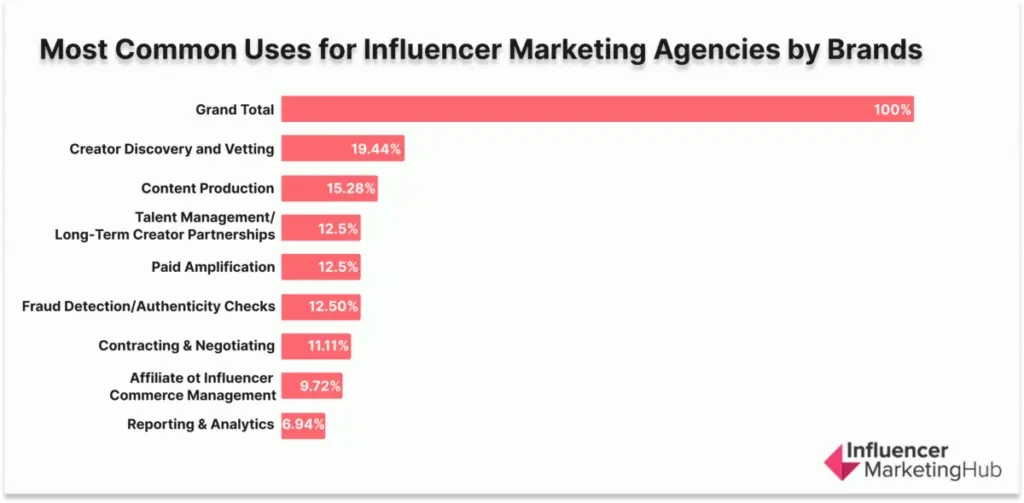
The selection is a strategic decision, not a casting exercise. And this means going beyond audience data to analyse the quality of the community a creator has built, the coherence of their track record, and the way they have managed previous collaborations. Micro-creators with 15,000 highly engaged followers in a specific niche can be infinitely more valuable than profiles with millions of followers but only a superficial connection with their audience. The data supports this: micro-influencers generate engagement rates of around 3.86% compared with 1.21% for mega-influencers, according to Influencer Marketing Hub data for 2025.
Then comes the negotiation, which in this context goes far beyond agreeing a fee and publication dates. It is the moment when the true nature of the collaboration is defined: how much creative freedom the creator has, what information they are given about the brand in order to speak about it with authority, and how content approval is handled without destroying authenticity in the process. A well-run negotiation lays the foundations of a relationship; it does not close a transaction.
The problem is not the availability of data, but the willingness to use it to learn. The brands that are seeing real results are those investing in long-term partnerships and having reasons to speak about them with conviction beyond sponsored posts. According to Ogilvy, the shift from episodic activation campaigns to ambassador models is the most significant trend in the sector for 2026.