
The end of static strategy: towards a system of rapid response and cultural relevance.
How do you go from studying Law to leading digital strategies in the age of AI? For Marina Hernández, Head…
9 April 2026

On 1st March, the red carpet at the 2026 Goya Awards became the stage for a conflict that had been quietly building for years. Dulceida, Laura Escanes and Jessica Goicoechea attended as guests of the Spanish Film Academy, and what should have been a minor style moment at a film gala turned into one of the most revealing cultural debates of the year.
This wasn’t a debate about fashion. It was a debate about who has the right to exist in the spaces where culture is shaped.
It would be easy to stay on the surface: actors upset, influencers defending themselves, and audiences taking sides. But the Goya controversy is not an anomaly, it is the most visible symptom of a structural tension that has been reshaping the rules around what culture is and who gets to legitimise it
The Film Academy itself had to clarify that the content creators attended as guests of the event’s sponsors, not the institution; a nuance that says a great deal about how the economics of these events actually work.
Weeks later, the Málaga Festival repeated the pattern: the festival confirmed that some creators were invited directly by the event, while others attended through sponsors, and that they are considered “another communication channel that helps promote the festival and expand its visibility to new audiences”.
The reaction from the industry was understandable, and there is something genuinely serious behind it. Actress Yolanda Ramos put it bluntly in a comment that went viral: “Nothing against influencers… but I was at home in my pyjamas. Except for when I was nominated and the following year, I’ve never been invited, neither before nor after.” Meanwhile, Mar Regueras used the moment to speak publicly about her disappointment with the profession, opening up a deeper conversation about working conditions in the sector. But conflating that reality with the presence of creators on a red carpet is to mix up two different problems. One is structural: the precarity of the Spanish audiovisual industry. The other is symbolic: the discomfort around who occupies spaces of visibility.
And the most honest response from the creator side came, paradoxically, from an influencer. Violeta stated that if her presence meant an actor couldn’t attend, she simply wouldn’t go. That sentence perfectly captures both what is genuine in this debate and what is merely surface-level noise.
If the Goyas lit the fuse, the Málaga Festival made it explode. Ona Gonfaus, 19, with 1.8 million followers on TikTok and 566,000 on Instagram, posed on the red carpet and, when a journalist asked her to recommend a Spanish film, replied: “The new one about eight surnames” — referring to the hugely popular comedy franchise that began with Ocho apellidos vascos, a film from 2023.
The moment instantly became symbolic for both sides of the debate. Carmen Maura, who premiered Calle Málaga that same day, was blunt: influencers “don’t make cinema”. Actor and comedian Marc Biarnés, with nearly 800,000 followers on his TikTok account @nosoloviernes, posted a video asking: “What are certain influencers doing at the Spanish film industry’s party? Nothing.” Director Isabel Coixet went even further in an opinion piece in El País: “We’ve built a world where creating something; a story, a character, an image someone won’t forget in 20 years, is worth less than accumulating followers.”
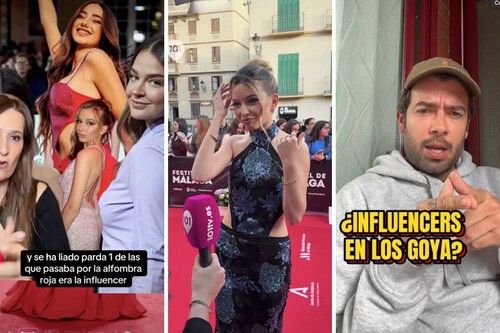 On the other side, Lola Lolita, also on Málaga’s red carpet, offered perhaps the most honest argument from the opposing camp: “In terms of cinema, obviously, I don’t belong here. But in terms of social media exposure and being able to showcase all this… I’m happy. And I’ll keep doing it every year as long as I’m allowed.” Xataka’s headline summed it up with surgical precision: “Lola Lolita has 13 million followers and Carmen Maura has four Goya Awards. And festivals are clear about who gets the red carpet.”
On X, the controversy sparked a wide range of reactions, such as that of @MyriamMunrriz.

“Spain and its love of controversy. Now it’s all about influencers showing up at the Goya Awards. I mean, Georgina Rodríguez goes to the Cannes Film Festival all the time… Any films from said lady?”
What’s revealing is that the same pattern keeps appearing in completely different contexts, showing that this is not a one-off controversy but a structural tension.
It’s happening in mass culture. The viral TikTok about a Rosalía concert follows exactly the same logic as the Goyas, just without the red carpet: the tension between those who have followed an artist for years and those who can project them to two million people in 48 hours. Who has more legitimacy, the long-time fan or the one who generates the greatest reach? The uncomfortable question remains unanswered.
@r3vista Se hace viral este momento de varias influencers en el concierto de Rosalía‼️👀 Fuente: Fabianasevillano
And it’s also happening in deeply rooted, identity-driven culture. Seville’s Holy Week or the Feria have, for years, been facing their own version of this dilemma: what happens when a highly codified space (with its own unwritten rules, aesthetics and community) starts to be occupied by content creators who turn it into material for their audiences?
The debate over whether this is promotion or appropriation, whether it amplifies or dilutes, is still unresolved. But the visceral reaction is exactly the same as at the Goyas or in Málaga. Which tells us that these are not isolated debates, but different expressions of the same underlying question.
And it’s not just a Spanish phenomenon. Ethan Hawke recently complained at the Berlin International Film Festival that Hollywood casting processes are prioritising Instagram follower counts. The attention economy is rewriting the rules globally, not just within Spain’s cultural industries.

“Ethan Hawke, on hiring actors based on their Instagram followings: It’s madness. If I don’t have that public platform, do I not have a career? Like his daughter, Maya Hawke, the American actor and director has publicly condemned a growing trend in the film industry: putting those who already live in the spotlight front and centre.”
Who defines culture today? For decades, the answer was: institutions. Awards, academies, specialised critics, publicly funded programmes, long-established festivals… These mechanisms acted as filters of legitimacy: if the Academy invited you, you were culture. If not, you weren’t.
What content creators have disrupted is not culture itself, but that mechanism of legitimisation. They’ve shown that attention, collective emotion and cultural conversation can be generated without institutional permission. And that destabilises something far deeper than a guest list.
Critic Paco Tomás is right in saying that the controversy “becomes a repository” (though perhaps not in the way he intended). What’s being deposited is not the decline of culture, but the evidence that legitimacy is no longer a scarce resource controlled by a few. And that, as eldiario.es points out, forces us to ask whether it still makes sense for events to invite creators, or whether the model itself needs to be rethought from the ground up.
From the perspective of an agency working at the intersection of culture, brand and audience, this debate has concrete implications.
Cultural institutions need to redefine their value proposition. If the Goyas or the Málaga Film Festival want to remain relevant to younger audiences, integrating content creators is not surrender, it’s acknowledging that the digital attention economy is part of the ecosystem they operate in. The question is not whether to invite them, but how to do so in a way that makes sense for all stakeholders. The fact that the Academy had to clarify that “they didn’t invite them” is a clear signal that the current model isn’t working for anyone.
@nova.mas Lola Lolita ha respondido en el Festival de Málaga a los comentarios que han surgido desde intérpretes como Yolanda Ramos por la notable presencia de influencers en los Premios Goya celebrados hace una semana, en lugar de actrices como ella misma. La creadora de contenido ha justificado que estas voces estén en este tipo de eventos ya que son un altavoz para las generaciones más jóvenes y acercarles así el cine español. #LolaLolita #PremiosGoya #cine #antena3 #novamas
♬ Sex And The City Main Theme (From “Sex And The City”) – Geek Music
Brands investing in culture need to understand this tension, not ignore it. There’s a huge difference between a brand sponsoring the Goyas to associate itself with a veneer of cultural prestige, and a brand that understands that the value of that sponsorship today is also, and perhaps primarily, measured by what happens on TikTok the next day. These aren’t incompatible goals, but they do require different strategies.
The debate around cultural legitimacy is not going away, it will intensify. Every time a content creator enters a space that was once exclusive; a red carpet, a high-profile concert, a centuries-old tradition. The same question will resurface. Brands, festivals, institutions and creators who learn to navigate that tension, rather than ignore or amplify it, will be the ones who build something more enduring.

“Andrea Duro, against the presence of influencers at the Goya Awards: You’re not doing cinema any favours.”
We don’t believe the answer lies in choosing sides. Neither in the nostalgia for a cultural ecosystem with controlled entry points, nor in the naïve assumption that more visibility always equals more cultural value.
What we do believe is that the question “who has the right to walk the red carpet?” is, ultimately, the wrong one. The right question is: how do we build cultural spaces that are at once relevant, rigorous and accessible in an ecosystem where attention is the main currency?
That requires more strategic intelligence and less trench warfare. It requires society to understand that legitimacy and visibility are not opposing forces. And it requires content creators to recognise that entering a cultural space also comes with responsibility for what happens within it.
The Goya debate is not over. It will keep resurfacing. In Málaga, at the Feria, at the next concert that sparks conversation. And each time it does, it will be telling us something about how culture is changing and how we can help ensure that change moves in a better direction.


