
Redefining Employee Advocacy: Why Uploading Content Isn’t Enough
In recent years, earned voice strategies that involve employees—commonly known as employee advocacy—have become increasingly prominent in many companies’ digital…
22 May 2025
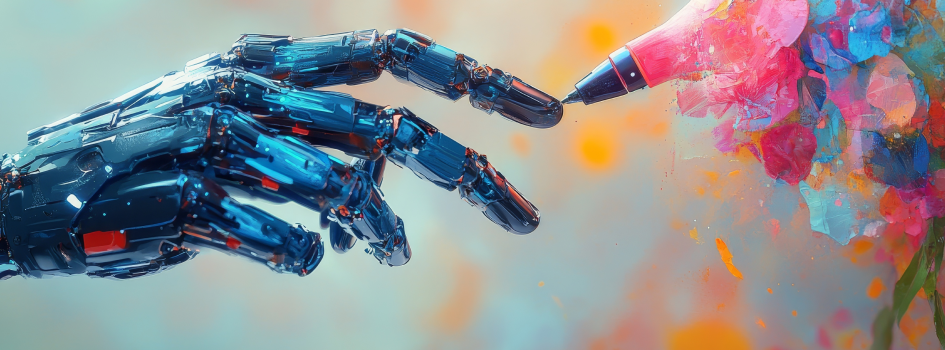
Generative Artificial Intelligence has become the star of today’s cultural moment. From the explosion of ChatGPT in late 2022 to the proliferation of tools like Midjourney or DALL·E for creating surreal images, society is mesmerised by the wonders (and potential threats) of generative AI.
In marketing, this phenomenon is even more evident: nearly 70% of marketers plan to use generative AI in their daily strategies, and many creatives can no longer imagine working without these new digital companions.
At the same time, unsettling questions arise: Can AI truly be creative or merely imitative? Will it replace human minds or enhance them?
Far from being a passing fad, generative AI represents a historical turning point.
And no—we’re not calling this a “golden age,” as ChatGPT cheekily suggested. But we will say this: creativity and technology are now more intertwined than ever, opening a new chapter for brands and agencies. And yes, we’re creatively thrilled. No apologies.
At Good Rebels, we’ve been exploring this landscape for a while. Not because it’s trendy, but because we knew the impact would be profound. Our stance is clear (and non-negotiable): AI doesn’t replace talent—it amplifies it.
We call it augmented creativity: a model where human imagination and algorithms collide, challenge each other, and—when things flow—create magic.
What will you find in this article that you haven’t read in countless other AI think pieces? Real-life use cases of how we use AI as a creative collaborator (never a substitute), and the principles we follow to integrate it into our workflow. We’re here to share what we’re learning—the good, the weird, and the parts we’re still figuring out.
We define augmented creativity as the combination of human intuition and the power of AI to elevate the creative process.
It’s not about replacing people with machines—it’s about using machines as allies that amplify our ideas. Generative AI can iterate infinitely, combine unexpected concepts, and challenge our biases, acting as a catalyst that expands our idea range and—most of all—accelerates their execution.
If traditional creativity is like a hand-crafted lab, AI adds an ultra-fast prototyping engine: turning ideas into tangible realities in seconds.
Before, many proposals stayed trapped in a notebook for lack of time, budget or feasibility. Now, they can be materialised and tested almost instantly: What if we try that concept in five styles? What if we rewrite that copy in another tone? What if we turn it into a micro-video?
Beyond improving results, this expands our creative range and helps us go much further.
Quality is still our only metric. AI can churn out content at speed—but quantity doesn’t mean quality. A recent MIT Sloan study warned that while AI significantly increases the amount of creative content, its effect on quality is more complex.
Because that creative spark still needs someone with judgment. And that—so far—no model can automate.
At Good Rebels, we treat AI like another member of the creative team. A peculiar one, yes. Something like a brilliant-but-chaotic trainee with no concept of boundaries or briefs.
We adopt a collaborative mindset. In practice, that means integrating AI into our daily workflow as a creative sparring partner that helps us push beyond our limits.
That said, the leadership stays with us. AI doesn’t understand cultural context, brand strategy, or emotional nuance the way an experienced creative does. Or, let’s be honest—like someone who uses TikTok in 2025. Each time we “collaborate” with AI, we do it with a creative mindset: we set the vision, give feedback, and force the model to iterate until it aligns with our goal.
AI can learn from our prompts—but we’re the ones who know when it’s right.
A common mistake is assuming AI has more judgment than it does. Left alone, the results are often bland and generic. We bring the taste, intuition, and sensitivity that turn an idea from just good into something meaningful. AI brings speed, volume, and improbable connections.
We don’t compete. We collaborate. In short: we treat AI like a highly talented assistant—one that still needs creative direction. The challenge isn’t using AI—it’s using it well.
To use AI in brand creativity, Good Rebels follows five key principles that blend human intuition with technological power—always grounded in strategy and ethics:

In short, interconnected principles that allow us to innovate without losing our essence.
Our AI workjourney shows how our principles of AI-powered creativity come to life in every step of the process: from strategic conception to multichannel execution, AI supports—but does not replace—human talent. Tools like Midjourney, ChatGPT, Krea, Runway, or ElevenLabs work as extensions of the creative team, multiplying our capacity but still requiring direction.
Integrating them comes with challenges, but we embrace a philosophy of continuous learning to master and combine them ethically. When we connect this entire process to the initial principles, we see a clear thread: strategy guides what we do with AI, human-AI collaboration enhances ideas, experimentation drives innovation and improvement, and ethics/authenticity ensures the result genuinely resonates with people.
That’s how, at Good Rebels, we practice what we preach: creativity augmented by AI, in which we trust to go further, faster and with greater impact—always with a rebel soul and human intelligence guiding the way.
But how do we put these principles into practice in our creative day-to-day? At Good Rebels, we integrate AI transversally across the creative process, focusing on three main areas of experimentation:

Generative visual AI allows us to turn ideas into images almost instantly, accelerating creative processes and multiplying the visual possibilities for brands.
Today, tools like Midjourney, Firefly, Krea, Everart, or even ChatGPT make it possible to:
All this adds speed, flexibility and volume of options, letting teams focus more on curating and deciding than on producing from scratch.
AI is also revolutionising sonic creativity. Today we can generate professional voiceovers, clone voices, localise scripts in multiple languages or even compose original music—without recording studios.
For brands, this means greater agility, personalisation, and versatility in videos, global campaigns or interactive experiences.
AI is redefining how video content is created and edited. You no longer need a full production team to bring an idea to life—now, a single image and a prompt are enough. This allows marketing teams to explore more, produce better, and deliver faster:
I talk about AI with my mum and she ignores me—until she asks me to show her how to ask ChatGPT for a watermelon gazpacho recipe because Aunt Mila is coming over for dinner and she wants to impress her.
Just over a year ago, I’d been messing around with my friends, chatting with “Chati” (my affectionate nickname for ChatGPT), while they looked on in disbelief and told me it would never be useful. Today, I tease them when they ask it mid-trip when and why Cleopatra died—or for a recommendation on where to find the best roast suckling pig in Madrid.
Naturally, I talk about AI at work too. A lot. So much that I even dream about it. Yes, I actually have dreams about Artificial Intelligence. But we’re living in a new era where nearly everyone—especially companies—will need to adopt AI in their processes, much like they did with the internet or social media back in the day. So the question is no longer if we should use it, but how and for what. The democratization of AI is already a reality.
In terms of creativity, paradoxically, the more accessible the technology becomes, the more valuable original human imagination is. If everyone can generate content using AI, we’ll face a flood of generic and repetitive messages. In fact, some experts warn that AI might push us into a “creative race to the bottom” if used unambitiously—reducing advertising to tired formulas.
The good news? It doesn’t have to be that way. The same tool that can make things banal can also be used to innovate and inspire. The difference lies in our mindset and methods. If the industry—advertisers and agencies alike—embraces AI with a desire to experiment and create new things, rather than just taking shortcuts, we can raise the global creative bar.
For brands, this means AI must be implemented in a way that aligns with their purpose and long-term vision. Not using AI just for the sake of it, but because it adds something meaningful to the story we tell customers. Maybe it helps personalise the experience better, create content so good it generates engagement, or helps you authentically tap into the latest cultural trend.
In all these cases, AI serves the brand’s strategy—not the other way around. Yes, I’ve been repeating this message throughout the article, but that’s because it matters—whether it’s through the humour of Domino’s, Toyota’s innovation, or Tinder’s rebellious spirit.
Looking to the near future, we see AI becoming more and more integrated: from generating thousands of ad variations for microsegmentation to helping planners simulate how the market might react to a campaign. Even in data management and automation, AI will be essential.
But in that ultra-technological landscape, differentiating creativity will be more crucial than ever to stand out in a sea of content. That’s why we talk about augmented creativity: because we believe that real creativity—the kind that moves people and builds brand value—doesn’t die with AI. It’s reborn, supercharged, for those who know how to use it.
At Good Rebels, we embrace this moment with excitement. At our core, we’re creative rebels who adopt the best tools to break the mould. Just as we were pioneers in digital transformation, we now embrace generative AI.
We’ve even launched a specialist division, Kuantik, to take AI innovation to the next strategic level—delivering tailored, AI-powered marketing solutions to our clients. This complements our vision of the agency of the future: one where data experts, technologists, designers and storytellers all collaborate, each enhanced by AI in their own domains.
And this, dear friends, is just the beginning. Or actually… maybe not even that anymore.


